

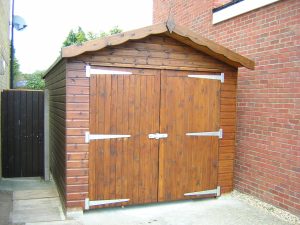
 If you need more space in your garden, a timber garage or large shed could be the answer. Whether you want somewhere to park a car, store garden tools, or keep equipment safe through winter, a well-built timber structure gives you lasting, practical space that also looks good.
This guide walks you through the main options, what to look for when buying, and what you need to know about planning rules in the UK.
Why Choose Timber?
Timber is one of the most popular materials for garden buildings in the UK, and for good reason. It is strong, natural-looking, and when built well, it can last for decades. Redwood pine is a common choice for high-quality builds because it holds up well against the British weather and resists rot better than cheaper softwoods.
Timber also works well with most garden styles. Whether your garden is modern or traditional, a well-finished wooden structure tends to blend in naturally.
Timber Garages: More Than Just Car Storage
A timber garage is a bigger investment than a standard shed, but it gives you much more flexibility. Most people think of garages as places to keep a car, but they can do a lot more than that.
Common uses include:
- Vehicle storage for cars, motorbikes, or bicycles
- Workshop space for woodworking, repairs, or hobbies
- Extra storage for garden machinery, seasonal items, or sports equipment
- Combined spaces with a loft area above for extra room
A bespoke timber garage can be designed around what you actually need. Features like workbenches, windows, electric sockets, and wide double doors can all be included from the start. The timber frame can also be fitted with insulation and internal lining if you want to use the space through the colder months.
When ordering, it is worth thinking about door width. A standard single garage door is usually around 2.1 to 2.4 metres wide, but many modern SUVs and vans need something wider. A good builder will discuss this with you before anything is made.
Large Garden Sheds: A Practical Storage Solution
Not everyone needs a full garage. For many households, a large shed is the right choice. Large garden sheds are well suited to storing garden tools, lawnmowers, outdoor furniture, barbecues, bikes, and anything else that needs to be kept dry and out of the way.
There are two main roof styles to choose from:
Apex roof – The classic pointed roof design. It gives good headroom in the middle of the shed and allows rain to run off quickly. A popular choice for larger sheds because it is sturdy and looks neat.
Pent roof – A single-slope roof that is lower at the back. Pent sheds are useful where there are height restrictions, for example close to a fence or boundary wall.
For large sheds, cladding quality matters a great deal. Shiplap cladding (where boards overlap) is one of the most weather-resistant options. Heavy-duty feather edge boarding, tanalised to resist rot, is another strong choice for sheds that will be in use for many years.
Comparing Your Options
Here is a quick comparison to help you decide which type of structure suits your needs:
| Feature | Standard Shed | Large Heavy Duty Shed | Timber Garage |
|---|---|---|---|
| Vehicle storage | No | No | Yes |
| Garden tool storage | Yes | Yes | Yes |
| Workshop potential | Limited | Yes | Yes |
| Insulation option | Rarely | Yes | Yes |
| Internal lining | No | Yes | Yes |
| Loft area possible | No | No | Yes |
| Planning permission likely needed | Rarely | Sometimes | Sometimes |
| Typical footprint | Up to 12 sqm | 12–30 sqm | 20 sqm+ |
Bespoke Builds: When Standard Sizes Do Not Fit
Sometimes a standard shed or garage simply does not match your space or your needs. Odd-shaped plots, specific size requirements, or unusual uses often call for a custom design.
Bespoke garden buildings are made to the exact dimensions and specification you need. This means you are not trying to squeeze your requirements into a set design that was made for someone else. A good builder will talk through your ideas, take measurements, and produce something that fits properly and works well.
Bespoke builds are also useful if you want a specific finish. For example, composite cladding can be added for a lower-maintenance exterior, or Farrow and Ball exterior paint can be used to match the colour of your house.
Do You Need Planning Permission?
This is one of the most common questions people have when thinking about a garden building. The good news is that most garden structures are covered by permitted development rights, which means you do not need to apply for planning permission.
However, there are rules. According to the Planning Portal, outbuildings including sheds and garages must meet certain conditions to qualify as permitted development. Key rules include:
- The building must be single storey
- Maximum eaves height of 2.5 metres
- Maximum overall height of 4 metres for a dual-pitched roof, or 3 metres for any other roof
- The building cannot be placed in front of the main wall of your house
- All outbuildings combined must not cover more than 50% of the garden area around the original house
If your property is a listed building, or you live in a national park, Area of Outstanding Natural Beauty, or conservation area, different rules apply and you may need to apply for permission regardless of size.
It is always worth checking with your local planning authority before work begins, especially for larger structures like garages.
What to Ask Before You Order
Before placing an order for any garden building, it helps to think through a few things in advance:
Size and layout – Measure your space carefully. Think about where doors will open and whether there is enough room to walk around the outside of the building for maintenance.
Base and foundations – A solid, level base is essential. Concrete, paving slabs, and timber frames are all common options. The right choice depends on the weight of the building and how the ground drains.
Cladding and treatment – All timber needs treatment to last. Look for buildings that include a quality wood stain or preservative as standard. Tanalised timber has been pressure-treated and lasts longer without additional maintenance.
Delivery and installation – Check whether installation is included. A reputable builder will deliver and erect the building for you, rather than leaving you with flat-pack components.
Built to Last Since 1951
Poulton Portables has been building bespoke timber garden buildings in Essex since 1951. Every structure is made by skilled craftsmen using quality Redwood pine and, where required, heavy-duty cladding options including composite boards that need little upkeep.
Whether you need a simple storage shed or a fully fitted timber garage with a loft, the team can design and build something that suits your garden and your budget.